Origins: a historic axis to the south
Long before it was a square, the site already corresponded to an important passage point.
In Gallo-Roman times, a road connected Lutetia (Paris) to Lyon, then to Southern Europe — a route that today corresponds to certain large avenues in the district. For centuries, this axis served as the main route out of Paris to the south, particularly in the direction of Italy. It is this function of passage that would permanently mark the identity of the place.
An old “gate” to Paris
Until the 19th century, Place d’Italie was not yet really part of Paris. It was located at the edge of the city, at what was called the Barrière d'Italie. At this point, a wall surrounded the capital: the wall of the Farmers General. Its role was not defensive, but fiscal: it served to control and tax goods entering Paris. The square was therefore an obligatory crossing point to enter the city, very busy but still little urbanized.
Why “Place d’Italie”?
The name may seem surprising, but it is actually very logical. The square owes its name to Avenue d’Italie, which starts directly from this crossroads. This avenue corresponds to the old road that connected Paris to Italy, notably via the famous Nationale 7. In other words, Place d’Italie was literally the starting point to the south… and to Italy.
Evolution of Place d'Italie
It was in the 19th century that everything changed. With Baron Haussmann's major works, Paris grew and modernized. The area was integrated into the capital in 1860, and Place d’Italie was developed as a major crossroads connecting several large avenues. Gradually, it became a central traffic point, a place of commerce and a structuring landmark for the 13th arrondissement. The square then took the form we know today.
Over time, Place d’Italie continued to evolve. In the 20th century, it became a veritable urban hub with the arrival of the metro, but also the development of transport and the urbanization of southern Paris.
In the 1960s, a major project called Italie 13 further transformed the landscape, with the construction of modern towers in the district.
These developments help make the square a unique blend of history and modernity.
A lively and easy-to-live-in district
Around the square, the atmosphere is both dynamic and pleasant. You will find shops, restaurants and services that are easily accessible on foot, which simplifies daily life.
The district remains lively without being overwhelming, which makes it suitable for both business trips and tourist visits.
A few minutes away, the Gobelins district offers a calmer and more historic atmosphere, which complements that of Place d’Italie.
A strategic location for getting around Paris
Place d’Italie is a real central point for getting around the capital quickly.
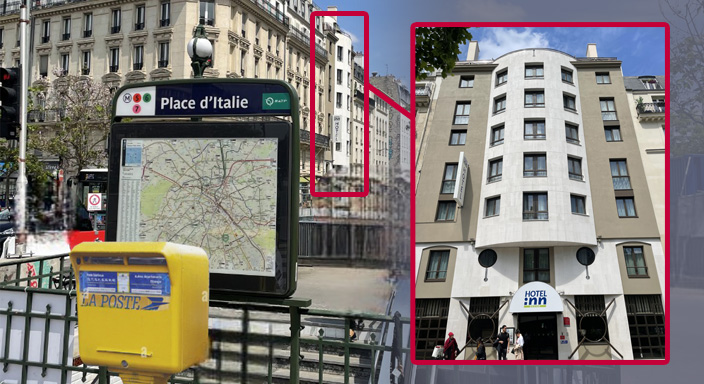
Thanks to metro lines 5, 6 and 7, you can easily access the center of Paris, the main tourist districts as well as business areas. This accessibility makes it a particularly practical choice for organizing your trips, without constraint.
Whether for a business trip, a seminar or a visit to Paris, you benefit from an environment that facilitates your daily life.
👉 Discover our rooms, as well as our seminar spaces and our equipment, to organize your stay in Paris 13 in the best conditions.